Apparel 2.0: a wholesale apparel catalog built for international buyers
A concept build for an international textile manufacturer selling wholesale — language and currency switching, a catalog filtered by fabric and country of origin, and a cart that ends in a quote request instead of a checkout. It is also the most fully art-directed build in the portfolio: a disciplined palette, certification marks carried from the hero down to the product card, and product photography staged for close inspection.
About the company on these screens. Apparel 2.0 is a Cogwheel concept build, not a client engagement. The manufacturer, its certifications, unit volumes, and every product, price, and quote shown are fictional demonstration content. What is real is the design and engineering — the localization, the filtering, and the wholesale-quote mechanics — which is what this page is about.
The brief
An apparel manufacturer selling wholesale into multiple countries needs a catalog that speaks the buyer's language, quotes in a currency the buyer recognizes, and is honest that a converted price is an estimate rather than a final number. Apparel 2.0 demonstrates that catalog for a fictional international textile manufacturer, built on the mechanics a bulk apparel order actually runs on: minimum order quantities, lead times, and color selection at the product level.
The build needed to carry a full storefront — browsing, filtering, a product detail page, a cart, and a quote request — without the localization or the wholesale mechanics ever reading as bolted onto a generic retail template.
Walk through it
Fifteen views across the platform. Select a thumbnail to change the frame, or open any image full screen.
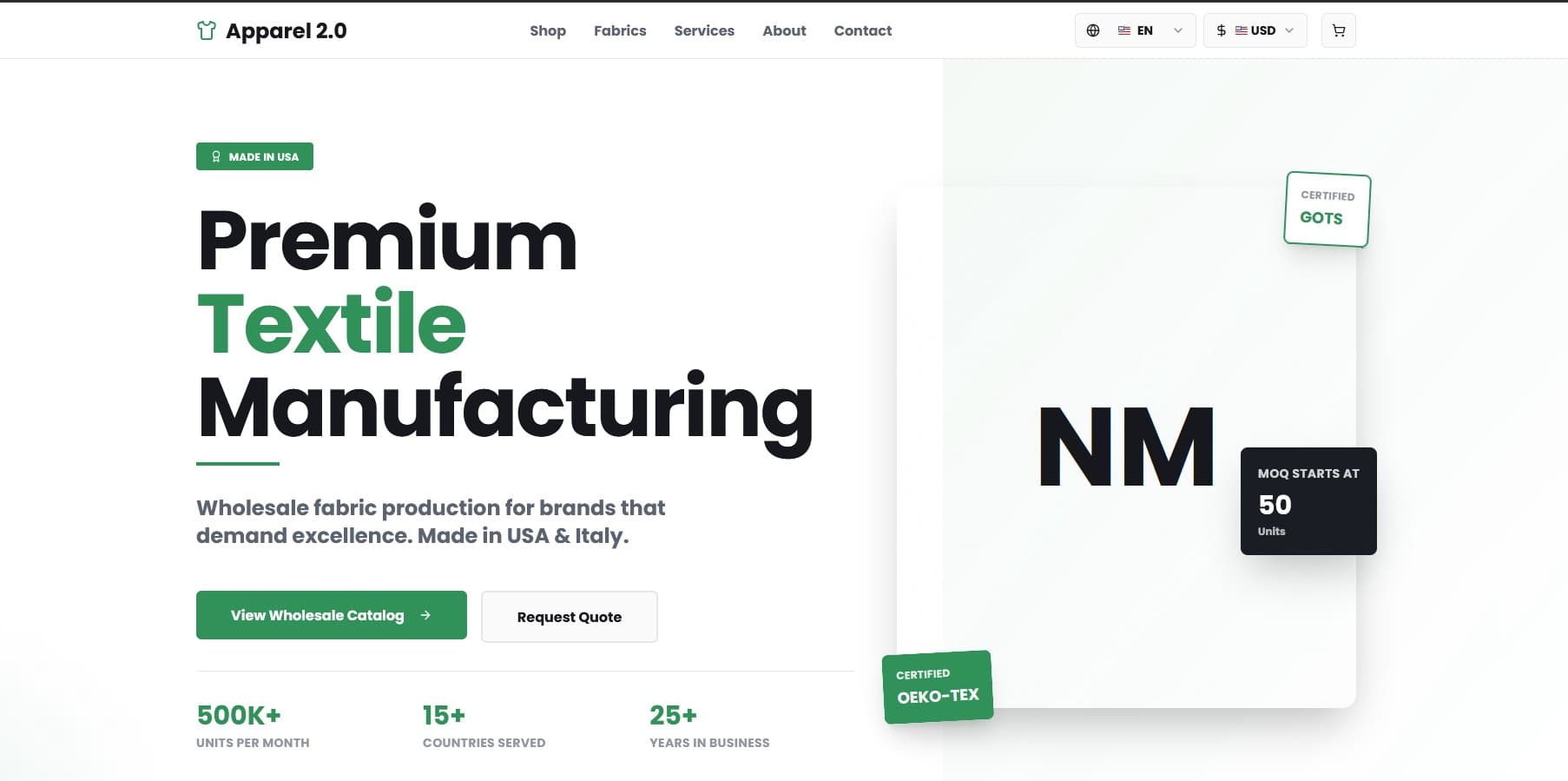
Modern E-Commerce Hero
Professional desktop hero section showcasing international e-commerce platform with compelling messaging and clear navigation
International Commerce
Full compliance with global e-commerce standards and regulations
Multi-Language
Seamless language switching for global customer accessibility
Localized Experience
Region-specific currency, shipping, and payment options
How it is built
A wholesale catalog carries more moving parts than a retail storefront — this is where those parts were made to feel like one considered system rather than a stack of features.
A visual system disciplined enough to carry credentials
The hero pairs a forest-green accent against a near-black wordmark and carries a Made in USA badge, a GOTS certification tag, an OEKO-TEX certification tag, and an MOQ callout without turning into clutter. Certification is surfaced again at the product level — GRS and OEKO-TEX tags sit directly on the product card — so credibility is not confined to the hero alone.
Language and currency kept as two separate decisions
A Region Settings panel lets a buyer set language and currency independently rather than collapsing both into a single flag picker, offering five languages and five currencies. It also states outright that converted prices use approximate exchange rates for reference only, rather than presenting a converted number as exact.
Filtering built for a manufacturing catalog
The Filter By panel puts Fabric Type — Pima Cotton, Bamboo, Modal, Hemp, Organic Cotton, Recycled Polyester, Tencel — and Made In — USA, Italy, Peru — next to Category as first-class filters, because a wholesale buyer shops by material and origin as much as by garment type.
A cart that ends in a quote, not a card number
The product page carries a minimum order quantity and a lead time next to the per-unit price, and the cart carries that logic through: its primary action is Request Quote, feeding an Items for Quote summary into a quote form rather than a checkout.
How the design carries the argument
Every screen in the walkthrough above is making the same case in a different register: this is a manufacturer built for buyers who order by the hundred, not the unit.
A confident opening, not a feature list
The hero leads with Premium Textile Manufacturing and Made in USA and Italy copy, backed immediately by an MOQ badge and certification badges, so the positioning is legible before a single product loads.
Localization surfaced, not tucked into a footer link
A language dropdown lives directly in the header for a quick switch, and a fuller Region Settings panel pairs language with currency in one place for a buyer who needs to set both.
The catalog argues by material and origin
Filter By and sort controls sit above a product grid, and the product card visible in it states fabric composition and certification marks directly on the card, so filtering and browsing use the same vocabulary.
Product detail built for close inspection
The product page pairs a dedicated full-screen zoom view with per-color swatches, treating a wholesale buyer’s need to verify material quality as seriously as it treats the price.
Built with
Wholesale mechanics treated as real product requirements
A retail cart only needs a total. A wholesale cart needs a minimum order quantity and a lead time on the product detail page, and a path to a human quote. Apparel 2.0 treats those as first-class screens — a Filter By panel keyed to fabric and origin, a dedicated Region Settings panel, an Items for Quote summary — rather than retrofitting a template built for single-unit checkout.
Want something built to this standard?
This is the level of design and engineering we bring to client work — whether that is a marketing site, a wholesale catalog, or the application behind it.