StaffAbility: a second-chance employment platform built to pitch two audiences at once
A public platform for StaffAbility, a second-chance employment program, built to make its dual-impact case to employers and justice-involved participants in the same visit — backed by a configurable economic impact simulator and an AI career-coach assistant.
The brief
StaffAbility is an organization proposing a model for second-chance employment: skills training mapped to high-demand industries, wraparound support such as housing and mentorship, and employer partnerships built around measurable retention and cost benefits rather than goodwill alone.
The site had to carry a dual pitch — persuasive to employers on retention and tax incentives, credible to participants on support and career pathways — while staying honest about what StaffAbility has proposed versus what it has already delivered. The model, the training programs, and the 2030 impact figures are labeled as a concept paper and a projection throughout the site itself, not asserted as finished outcomes.
See the platform
Nine views from the live site. Select a thumbnail to change the frame, or open any image full screen.
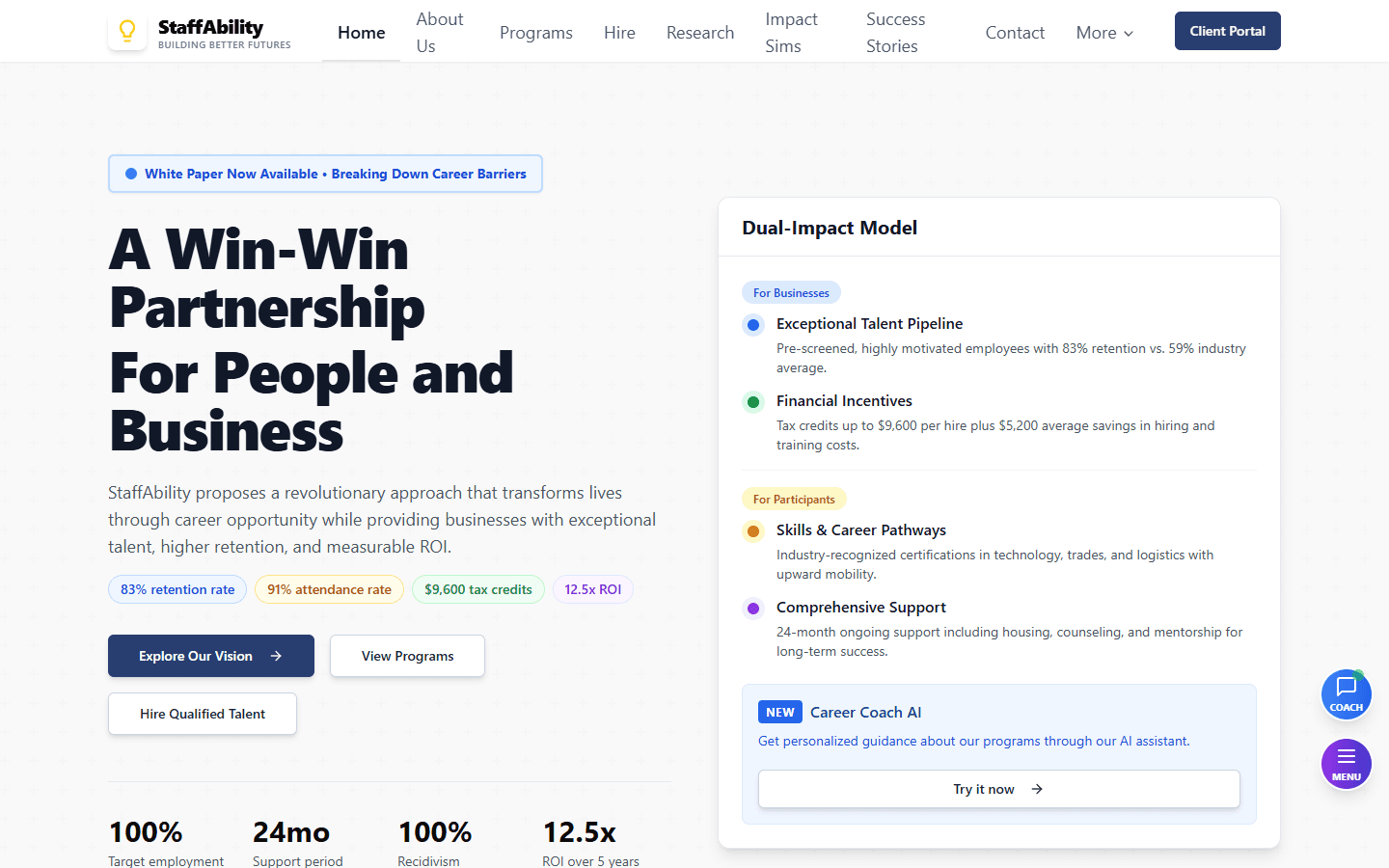
Homepage & Dual-Impact Model
The homepage hero splits its Dual-Impact Model card into "For Businesses" and "For Participants" panels, backed by four stat pills the site states for itself (83% retention rate, 91% attendance rate, $9,600 tax credits, 12.5x ROI), plus a "NEW" callout for the Career Coach AI assistant.
Second-chance employment
A dual-impact model presented for both employers and participants
AI Career Coach
An assistant for personalized program guidance
Economic Impact Simulator
Configurable city, participant count and program parameters
How it is built
The distinctive piece is the economic impact simulator — a configurable tool rather than a static claim — sitting alongside a dual-audience pitch and an AI assistant built into the same flow.
An economic impact simulator with real levers
A dedicated "Impact Sims" tool lets a visitor pick a city, set a support type and a participant count (100 to 5,000), and choose an analysis timeframe, then calculates the projected economic impact of a second-chance employment program against that configuration — the page brands its own output "audit-ready, defensible metrics" and lists its methodology sources.
One model, two audiences addressed directly
The homepage hero splits its Dual-Impact Model into a "For Businesses" panel and a "For Participants" panel side by side. Further down, a dedicated employer-benefits section goes deeper on the business case alone, then leads straight into the success-story profiles that carry the participant side — so neither audience has to read past the other's pitch to find their own.
An AI career coach built into the pitch, not bolted on
A "NEW: Career Coach AI" callout sits directly inside the homepage's Dual-Impact Model card with its own "Try it now" action, and a "Coach" chat bubble stays anchored in the corner of every page in the gallery — reachable from wherever a visitor lands, not just from one promo card.
Proposed figures labeled as proposed
Sections that model future outcomes say so on their own labels — a "Concept Paper" tag over the training pathways, "Proposed Impact by 2030" over the 2030 projections, and "StaffAbility Model: Projected Impact" over its 100% target-employment and recidivism-elimination goals — keeping the pitch legible as a model rather than a claim of results already delivered.
How the site argues its case
With two audiences and a mix of live figures and future projections to keep straight, the order of the page and the labeling on each section are doing real work.
The scale of the problem, in the site's own terms
The white paper section states the justice-system numbers behind the pitch — a 67% three-year recidivism rate, $182B+ in annual incarceration-related cost, and a 27% unemployment rate for formerly incarcerated people — framed as the scale of a system-wide problem, not as a result StaffAbility claims for itself.
A pitch built for two audiences, not one
The homepage leads with Dual-Impact Model panels addressed separately to businesses and to participants, and the employer-benefits section runs straight into the success-story profiles that follow it — so the case for hiring and the case for enrolling each get their own space rather than one crowding out the other.
Evidence offered at more than one depth
A visitor can stop at a homepage stat pill, go one level into the Research & Case Studies grid, or go all the way into the downloadable White Paper & Impact Report 2.0 — the site offers its case at three different depths rather than only the shallowest one.
Projections kept visibly separate from results
The site is candid about which of its own numbers are targets rather than track record: "Proposed Impact by 2030," "StaffAbility Model: Projected Impact," and a "Concept Paper" tag all sit directly on the sections they qualify, rather than in a disclaimer elsewhere on the page.
Built with
Client work, not a demonstration
StaffAbility is a real second-chance employment program — the mission, the training pathways, and the figures on these screens are the organization's own stated numbers, goals, and projections about second-chance employment, not placeholder content and not results this engagement produced. The task here was to give a proposal-stage model a platform credible enough for both an employer's diligence and a participant's trust, without ever presenting a projection as a delivered result.
Want a platform built for two audiences at once?
This is the level of design and engineering we bring to client work — whether that is a dual-sided platform, an interactive modeling tool, or the application behind it.