Unbarred Labs: a site for a justice-reform research and advocacy organization
A public-facing platform for Unbarred Labs, a research and advocacy organization working to remove the barriers that keep justice-impacted Americans out of voting booths, jobs, and housing after their sentence ends. Built to state that mission credibly and give a growing body of research somewhere to live.
The brief
Unbarred Labs is a research and advocacy organization working to remove the barriers — voting restrictions, employment discrimination, housing restrictions, and limits on civic participation — that keep justice-impacted Americans locked out of full participation in society after their sentence ends.
The site had to do two jobs for a live organization rather than a demonstration: state that mission in a way that reads as credible to funders and policymakers, and give a growing body of state-by-state research a structure it can keep publishing into without the catalog ever looking more finished than it is.
See the platform
Seven views from the live site — five from the homepage, then two from inside the Voting Rights Lab. Select a thumbnail to change the frame, or open any image full screen.
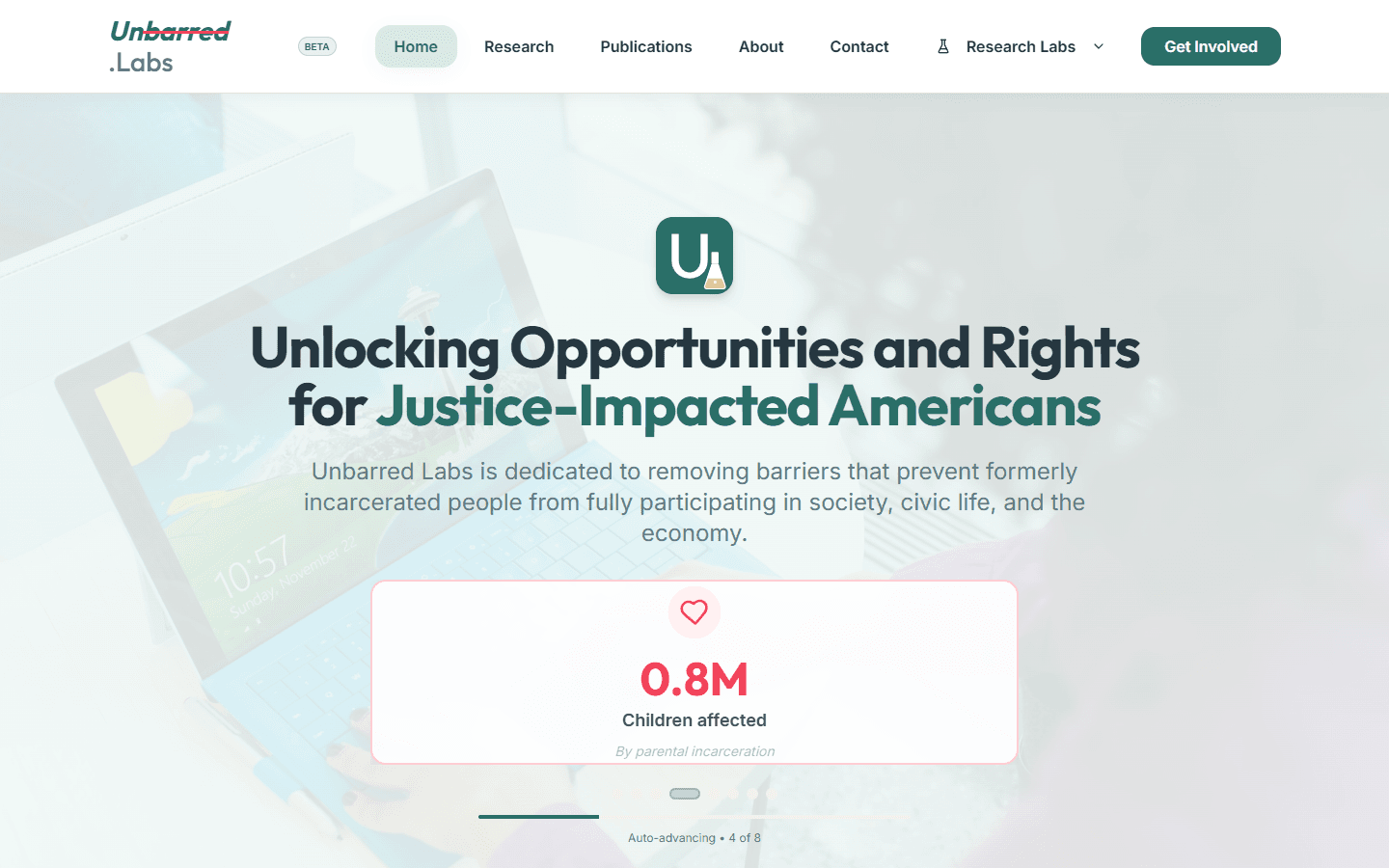
Homepage
The mission stated up front over a soft photographic hero. The stat card beneath it auto-advances through eight framings of the problem, with a progress bar marking its position in the cycle — this capture caught 4 of 8, "0.8M children affected by parental incarceration". Which figure a visitor meets depends on when they arrive, which is the point of building it as a rotation rather than one fixed number.
Criminal Justice Reform
Research and advocacy platform for justice-impacted Americans
Policy Modelling
Disenfranchisement totals recomputed across four reform scenarios
Interactive Mapping
A zoomable state-by-state map reachable by keyboard as well as pointer
How it is built
The site had to carry two registers at once: emotionally direct on the homepage, and structured enough elsewhere to hold a research library that is still growing.
An auto-advancing evidence carousel
The homepage hero leads with a rotating stat card — labelled "1 of 8" with its own progress bar — rather than a single static figure, so the same hero can carry several of the organization's headline numbers without competing for space.
A research library that scales honestly
The research topics grid lays every track out as a uniform card, each carrying its own status badge — Active or In Progress — so the site can publish work as it happens instead of implying a finished catalog.
Photography that keeps the mission human
Full-bleed photography sits beside the copy throughout — a presentation in an exposed-brick venue next to the barrier categories, a group with their arms around each other facing a landscape next to the vision statement — alongside the page's icon graphics, not replacing them.
A second product, integrated rather than bolted on
Unbarred.ai, the organization's AI-powered reentry support companion, gets a promo banner on the homepage, a dedicated feature callout on the about section, and its own link in the site footer, built into the same visual system rather than treated as an afterthought.
Research topics that open into interactive labs
The active track is not a PDF. The Voting Rights Lab shades every state by its felony disenfranchisement rate on a zoomable map, ranks the highest-impact states with a count and a rate each, and recomputes its totals against four policy scenarios — current law, restore upon release, restore after supervision, full restoration. Its own instruction is to click, tab or hover, so the map answers to a keyboard as well as a mouse.
A tool that shows its own arithmetic
The lab's election-impact section is laid out as five numbered steps rather than a single headline number: the disenfranchised total, a party split taken from published research, the resulting vote counts, the net margin, and that margin applied to the real 2024 result. A stated methodology block names the assumption underneath, which on a subject this contested is the difference between a model and an assertion.
How the site builds trust
Order matters here as much as it does anywhere else. What the page shows first, and how it labels what is unfinished, is doing real work.
Scale stated before the ask
The homepage opens on the size of the problem — a stat card citing 70M Americans with criminal records — before it asks the visitor to explore research or get involved.
Barriers named specifically
Rather than a general reform pitch, "The Challenge We Face" names four concrete restriction categories: voting, employment, housing, and civic participation, each with its own icon and one-line explanation.
Vision paired with mechanism
The vision section states two levers side by side — removing barriers and driving research — so the mission reads as a plan rather than an aspiration.
Research shown as work in progress
The research grid pairs one Active topic — Voting Rights Restoration, the one with a working lab behind it — with six more marked In Progress, and says so on every card, instead of presenting an unfinished body of work as a completed one. The Active card reads Explore Research; the other six read Preview (In Progress).
Built with
Client work, not a demonstration
Unbarred Labs is an active research and advocacy organization — the mission statement, the research agenda, and the figures on these screens are the organization's own subject-matter statistics about incarceration and disenfranchisement, not placeholder content and not results this engagement produced. The task here was different from a concept build: fit a growing library of real research into a system that scales, without ever making it look more finished than it is.
Want a site built for real stakes?
This is the level of design and engineering we bring to client work — whether that is an advocacy platform, a research library, or the application behind it.